
Elastic modulus
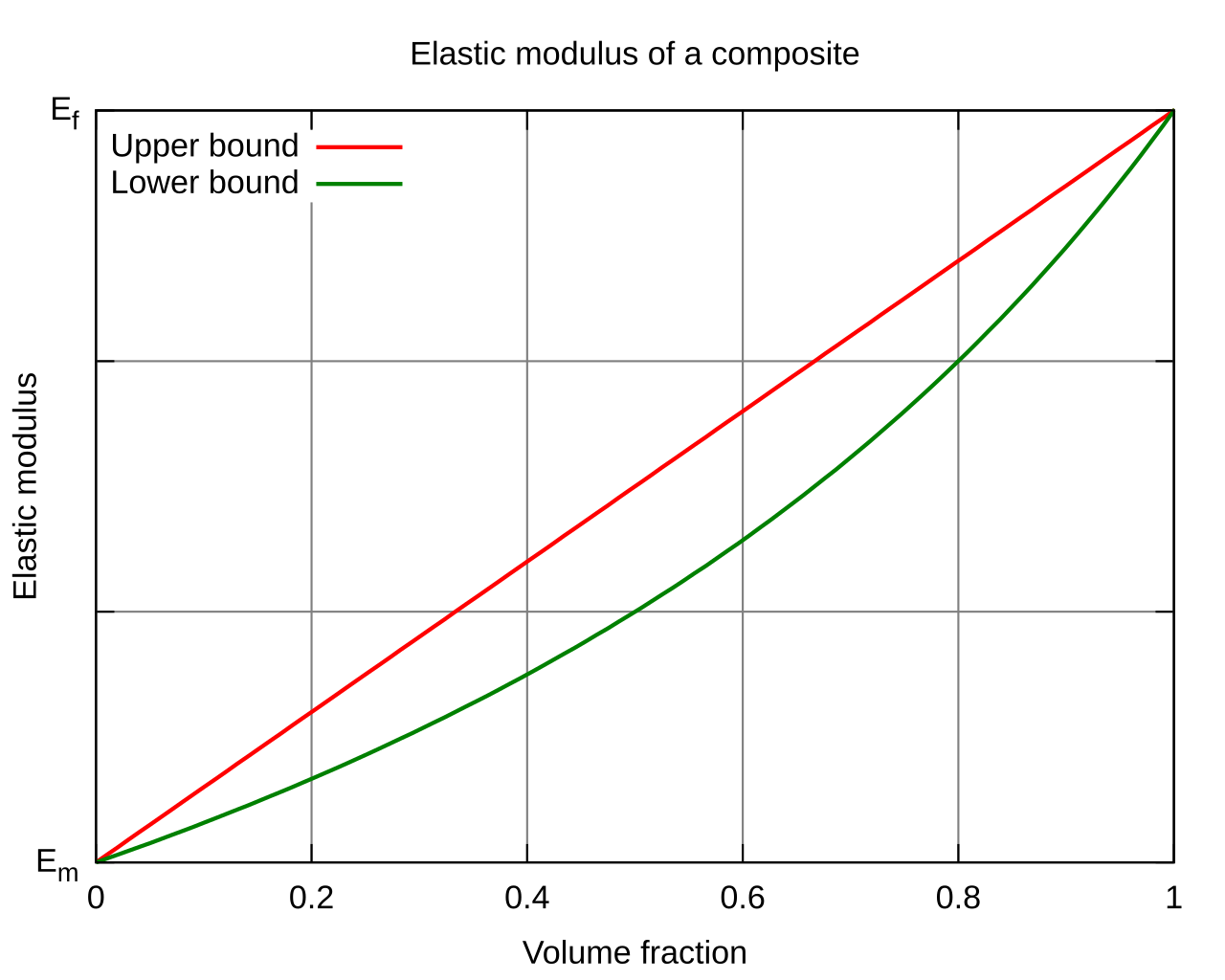
A measure of a material's resistance to elastic deformation.

Arbitrarily0 · CC BY-SA 3.0
An elastic modulus is a quantity that describes an object's or substance's resistance to being deformed elastically (i.e., non-permanently) when a stress is applied to it. The elastic modulus of an object is defined as the slope of its stress–strain curve in the elastic deformation region; a stiffer material will have a higher elastic modulus. Elastic constants are specific parameters that quantify the stiffness of a material in response to applied stresses and are fundamental in defining the elastic properties of materials.
- definition
- Slope of stress–strain curve in elastic deformation region
- formula
- δ = stress / strain
- primary types
- Young's modulus (E), shear modulus (G), bulk modulus (K), flexural modulus (Eflex)
- units
- Same as units of stress (since strain is dimensionless)
- special case
- Fluids at rest have shear modulus and Young's modulus always zero
- calculation method
- Density functional theory (DFT) using software such as VASP, Quantum ESPRESSO, or ABINIT
Lore & Background
The elastic modulus is defined as the slope of the stress–strain curve in the elastic deformation region, with a stiffer material having a higher elastic modulus. It takes the form δ = stress/strain, where stress is force divided by area and strain is the ratio of change in a parameter to its original value. Since strain is dimensionless, the units of elastic modulus are the same as those of stress. Specifying how stress and strain are measured, including directions, allows for many types of elastic moduli to be defined, with the four primary ones being Young's modulus, shear modulus, bulk modulus, and flexural modulus.
Reader's Guide
The elastic modulus is a fundamental concept in materials science and engineering, quantifying how a material resists elastic deformation under stress. Its significance lies in its ability to characterize material stiffness, which is critical for designing structures and components that must withstand loads without permanent deformation. The four primary types—Young's modulus (tensile/compressive), shear modulus (shear deformation), bulk modulus (volumetric compression), and flexural modulus (bending)—each describe different deformation modes. For homogeneous and isotropic materials, any two elastic moduli fully describe linear elastic properties, and others can be calculated. Fluids at rest are a special case, as they cannot support shear stress, making their shear modulus and Young's modulus zero. Modern computational methods, such as density functional theory, allow reliable calculation of elastic moduli by simulating stress-strain responses under controlled deformations, providing essential data for predicting material behavior in engineering applications.
Did You Know?
- The elastic modulus is defined as the slope of the stress–strain curve in the elastic deformation region.
- Since strain is dimensionless, the units of elastic modulus are the same as the units of stress.
- Fluids at rest cannot support shear stress, so their shear modulus and Young's modulus are always zero.
- Density functional theory (DFT) can be used to calculate elastic moduli using software such as VASP, Quantum ESPRESSO, or ABINIT.
Mathematical Definition and the Linear Elastic Regime
Young's modulus, conventionally denoted by the letter E, captures a fundamental mechanical relationship: the ratio of tensile or compressive stress to the resulting axial strain, provided the material remains within its linear elastic region. Stress in this context means force distributed over a unit cross-sectional area, while strain is a dimensionless quantity describing how much the material has proportionally deformed along the axis of loading. In the International System of Units, this property is expressed in pascals, and for most engineering solids the typical values fall in the gigapascal range. The concept sits squarely within Hooke's law, where stress is directly proportional to strain and the proportionality constant is precisely this modulus. It plays a role analogous to a spring constant in linking applied force to displacement, yet it carries dimensions of pressure rather than force per unit distance, making it an intrinsic material property that is independent of the object's particular shape or size.
Historical Roots and the Question of Naming
The name "Young's modulus" credits the nineteenth-century British scientist Thomas Young, yet the intellectual lineage stretches considerably further back. The word "modulus" itself traces to the Latin root modus, meaning "measure," a fitting etymology for a quantity that quantifies how much a solid resists being stretched or compressed along its length. The naming convention thus reflects a common pattern in science: a concept is refined and popularized by one figure, while its true genesis belongs to earlier, sometimes less widely recognized, contributors. The progression from Euler's theoretical groundwork through Riccati's experimental validation to Young's formalization illustrates how mechanical properties accumulate over generations of careful inquiry.
From Perfect Rigidity to Complete Softness
Young's modulus occupies a spectrum that runs from an idealized rigid body, which would demand an infinite value because no finite stress could produce any measurable strain, all the way down to a fluid-like substance that deforms freely under the slightest pressure and thus registers a modulus of zero. Real materials fall between these extremes. Rubber, for instance, exhibits a low modulus: applying a modest tensile or compressive load produces a relatively large change in length. Aluminium, by contrast, has a high modulus, so the same pressure yields only a small dimensional change. Within the linear elastic region, deformation is fully reversible; remove the load and the solid snaps back to its original shape. The boundary of this region is marked by the elastic limit, also called the yield point, beyond which the material no longer regains its form. The higher the modulus, the greater the stress required to achieve a given strain, making the property a direct indicator of a solid's axial stiffness.
Engineering Applications and the Broader Elastic Toolkit
In practice, Young's modulus lets engineers predict how much a bar of isotropic elastic material will elongate under tension or shorten under compression, and it also feeds into calculations of deflection for statically determinate beams loaded between their supports. These applications assume uniaxial stress, meaning loading in a single direction with no stress in the perpendicular axes. For more complex elastic problems, one or two additional parameters enter the picture: the shear modulus G, the bulk modulus K, and Poisson's ratio ν. Any two of these constants are sufficient to determine all the others for a homogeneous isotropic material through well-known algebraic relations. A striking applied example comes from biomedical research, where cancerous skin tissue has been measured at an average Young's modulus of 52 kilopascals and a Poisson's ratio of 0.43 ± 0.12, suggesting that elasticity mapping could evolve into a clinical diagnostic tool. It is also important to distinguish modulus from related but separate properties such as strength, geometric stiffness, hardness, and toughness.
Gallery


Frequently Asked Questions
What is elastic modulus?
Elastic modulus is a numerical value that captures how strongly a material resists temporary, reversible deformation when a stress is applied to it. It is defined as the slope of the stress–strain curve within the elastic region, so a steeper slope corresponds to a stiffer substance.
What are the primary types of elastic modulus?
The most commonly referenced elastic moduli are Young's modulus (E), shear modulus (G), bulk modulus (K), and flexural modulus (Eflex). Each one isolates a particular deformation mode—tensile, shear, volumetric, or bending—so engineers can select the right constant for a given problem.
How do you calculate elastic modulus in practice?
Experimentally, you determine it by measuring the slope of the linear portion of a stress–strain curve; theoretically, researchers often compute it via density functional theory (DFT) using packages such as VASP, Quantum ESPRESSO, or ABINIT. The underlying relationship is simply modulus equals stress divided by strain.
What units does elastic modulus carry?
Because strain is a dimensionless ratio, the elastic modulus inherits the same units as stress, most commonly pascals (Pa) in the SI system. In practice you will see values quoted in gigapascals or terapascals for everyday engineering materials.
Why is elastic modulus important in classical mechanics?
It is the fundamental parameter that links applied forces to recoverable shape changes, making it essential for predicting how beams, springs, and other structures respond under load. Without it, you cannot quantify stiffness or design components that must return to their original geometry after unloading.
More in Classical Mechanics 1-21
Spotted an error? Know more?
This is a living reference — every entry is fact-audited, and reader corrections feed straight into our audit queue. Suggest an edit · See this site's audit record