Drag (physics)
A force opposing motion through a fluid, dependent on velocity.

Nubifer // Wiki LIC (Spanish translation) · CC0
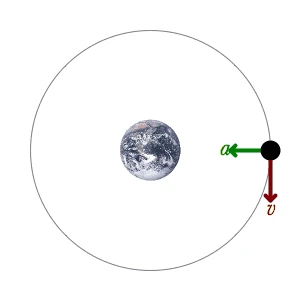
Drag, also known as fluid resistance or viscous force, is a force in fluid dynamics that acts opposite to the direction of motion of an object moving through a fluid. It can occur between fluid layers or between a fluid and a solid surface, and it tends to decrease the fluid's velocity relative to the solid object. Unlike other resistive forces, drag depends on velocity, being proportional to relative velocity at low speeds and to velocity squared at high speeds, with the Reynolds number distinguishing these regimes.
- field
- Fluid dynamics
- known_for
- Force opposing motion through a fluid; includes form drag, skin friction drag, lift-induced drag, wave drag, and parasitic drag
Lore & Background
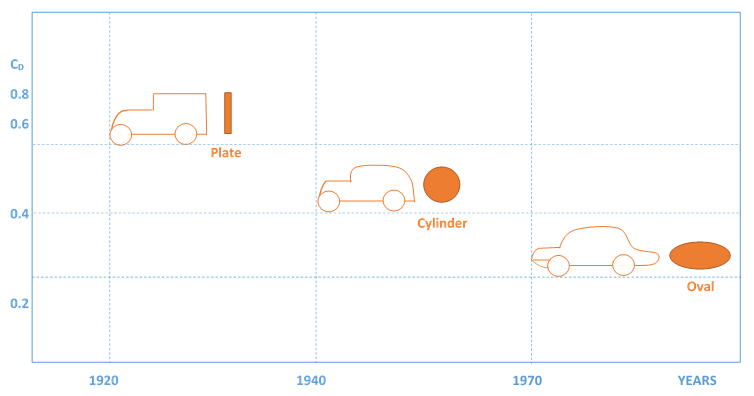
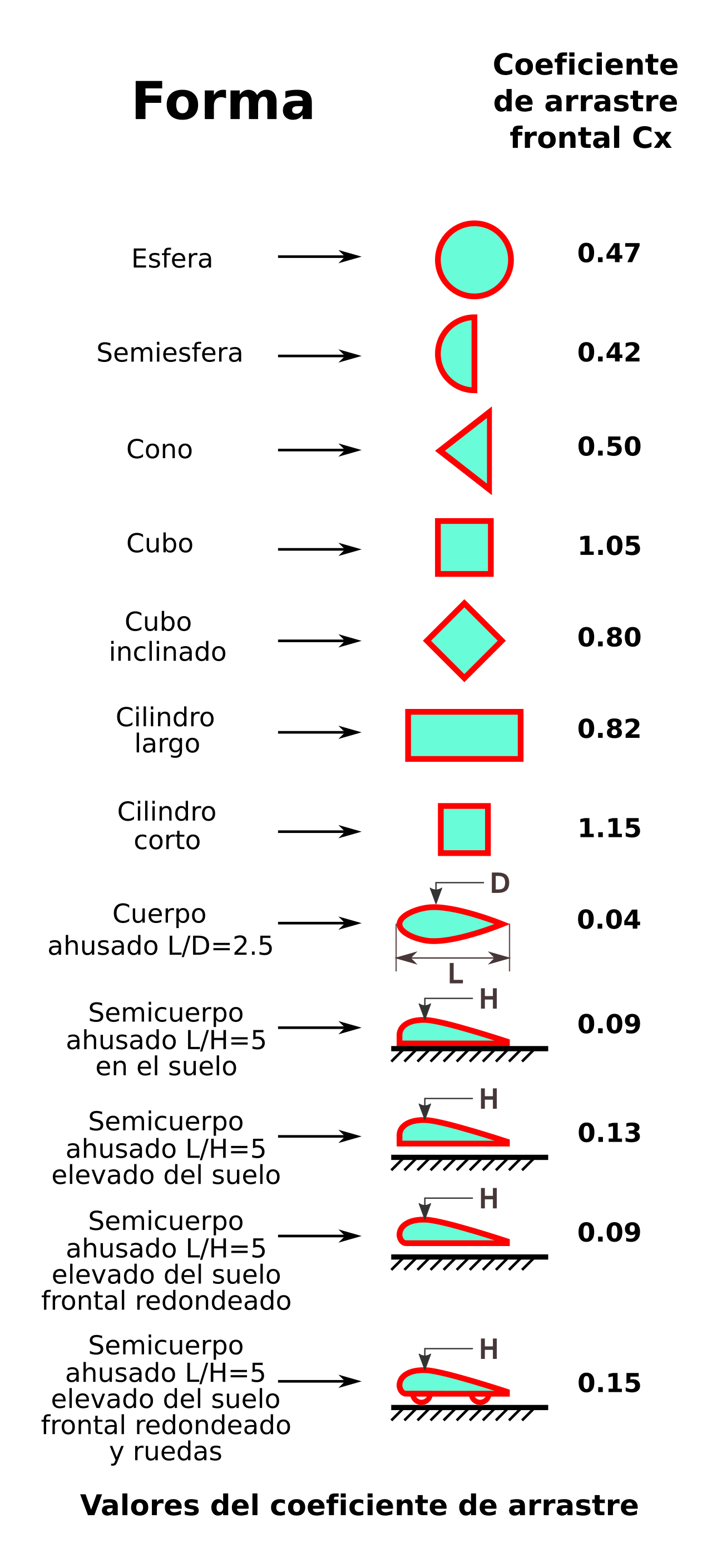
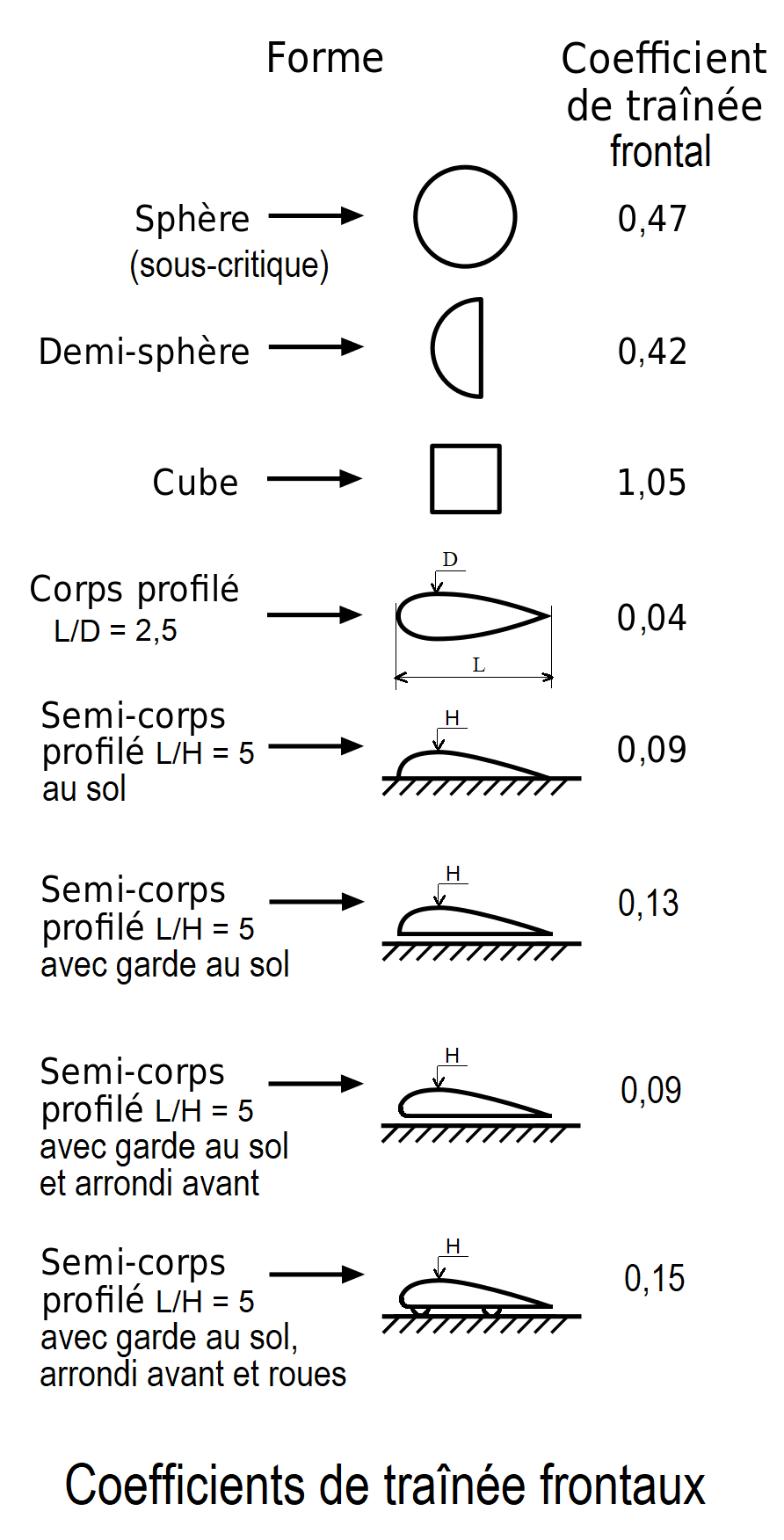
Drag is categorized into several types based on physical interactions. Form drag arises from pressure exerted on an object as fluid flows around it, determined by cross-sectional shape and area. Skin friction drag results from friction between the fluid and the object's surface, whether external (e.g., boat hull) or internal (e.g., pipe bore). For aircraft, lift-induced drag occurs with the creation of lift, involving trailing vortices and additional viscous drag, while wave drag appears at subsonic speeds when local flow becomes supersonic, as seen with the Concorde prototype where the area rule reduced wave drag by 1.8% at Mach 2.
Reader's Guide
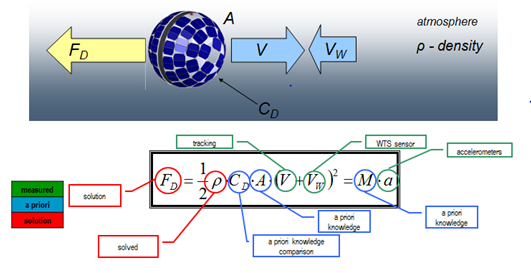
Drag is a fundamental concept in fluid dynamics, influencing the design and performance of vehicles, sports equipment, and fluid systems. The drag equation, F_D = 1/2 ρ v^2 C_D A, relates drag force to fluid density, speed, drag coefficient, and cross-sectional area. The drag coefficient depends on shape and Reynolds number. For aircraft, parasitic drag (sum of form and skin friction drag) and lift-induced drag vary with speed; at low speeds, induced drag dominates, while at high speeds, parasitic drag increases, and wave drag appears at transonic speeds. The equivalent parasite area, such as 2.20 m² for the Douglas DC-3 and 1.91 m² for the McDonnell Douglas DC-9, provides a comparative measure. Understanding drag allows optimization of efficiency, as seen in the minimum drag airspeed for maximum endurance or gliding range.
Did You Know?
- Drag force is proportional to relative velocity for low-speed flow and to velocity squared for high-speed flow, distinguished by the Reynolds number.
- For a top sprinter, overcoming drag can require 5% of their energy output.
- The wave drag of the Concorde prototype was reduced by 1.8% at Mach 2 by extending the rear fuselage 3.73 m.
- The Douglas DC-3 has an equivalent parasite area of 2.20 m², while the McDonnell Douglas DC-9 has 1.91 m².
Birth from the Shoulders of Giants
It grew from the accumulated theoretical and experimental work of Albert A. Michelson, Hendrik Lorentz, Henri Poincaré, and others, who had already wrestled with the puzzles of electromagnetism and motion. Einstein synthesized their findings into a coherent framework, and figures like Max Planck and Hermann Minkowski later refined and extended the mathematics.
The Two Postulates and Their Shattering Consequences
First, the laws of physics hold identically for every observer in an inertial frame. Second, the speed of light in a vacuum is invariant—it does not change no matter how the source or the observer moves. From these two simple statements flow a cascade of counterintuitive results. Simultaneity becomes relative: two events that appear simultaneous to one observer may be staggered in time for another in relative motion. Moving clocks tick more slowly, and objects contract along their direction of travel. Nothing—no object, no signal, no gravitational influence—can exceed the speed of light. Perhaps most famously, mass and energy prove to be interchangeable, captured in E = mc². The mathematical backbone shifts from Galilean transformations to Lorentz transformations, and the framework naturally accounts for the null result of the Michelson–Morley experiment.
Curving Spacetime: The Geometry of Gravity
General relativity reimagines gravity not as a force pulling objects together but as a geometric property of spacetime itself. The starting point is the equivalence principle: standing still on Earth's surface is physically indistinguishable from accelerating through empty space. This means free fall is actually inertial motion—an object in free fall feels no force at all, contradicting the Newtonian picture where gravity is an active pull. To reconcile this with special relativity, Einstein proposed that spacetime is curved. Working with mathematician Marcel Grossmann, he realized that the appropriate mathematical language was Riemannian geometry, a framework developed in the 1800s. The consequences are profound: clocks tick slower deeper in gravitational wells, planetary orbits precess in ways Newton's theory cannot explain as seen in Mercury's orbit and binary pulsars, light rays bend near massive bodies, and rotating masses drag the surrounding spacetime with them.
From Skepticism to Cosmic Cornerstone
Special relativity won broad acceptance by the 1920s, quickly becoming indispensable in atomic physics, nuclear physics, and the emerging field of quantum mechanics. General relativity, by contrast, struggled for relevance. Its predictions offered only small corrections to Newtonian gravity, its assertions lived on astronomical scales that seemed beyond experimental reach, and its mathematics was so demanding that only a handful of physicists could follow it. Each phenomenon fit neatly into the relativistic framework. Over the 20th century, relativity reshaped theoretical physics and astronomy, underpinning the nuclear age, advancing the study of elementary particles, and predicting extraordinary objects like neutron stars, black holes, and gravitational waves.
Gallery


Frequently Asked Questions
Who is Drag (physics)?
Drag is the resistive force in fluid dynamics that pushes back against any object moving through a fluid, acting directly opposite to the direction of travel. It can arise between layers of fluid itself or between a fluid and a solid surface, always working to reduce the relative velocity between the two.
What are Drag's powers and sub-types?
Drag manifests in several distinct forms, including form drag from pressure differences around a body, skin friction drag from viscous shear at the surface, lift-induced drag tied to wingtip vortices, wave drag from surface ripples, and parasitic drag as a catch-all for non-lift-related resistance. Together these sub-types account for nearly all energy loss an object experiences while plowing through air or water.
How does Drag scale with velocity?
At low speeds the force grows in direct proportion to the object's relative velocity, while at high speeds it scales with the square of that velocity. The Reynolds number is the dimensionless quantity that tells you which regime you are in, separating the linear low-speed behavior from the quadratic high-speed behavior.
Why is Drag important in classical mechanics?
Drag is the primary reason vehicles, projectiles, and swimmers must continually expend energy just to maintain speed, making it central to engineering design and trajectory planning. Without accounting for drag, predictions of motion through air or water would be wildly inaccurate, so it is a non-negotiable term in any realistic force balance.
What sets Drag apart from other resistive forces?
Unlike a simple constant friction force, drag is inherently velocity-dependent, meaning its magnitude changes as the object speeds up or slows down. This velocity coupling, governed by the Reynolds number, gives drag a nonlinear character that makes fluid-motion problems far richer than dry-friction counterparts.
More in Classical Mechanics 1-21
Spotted an error? Know more?
This is a living reference — every entry is fact-audited, and reader corrections feed straight into our audit queue. Suggest an edit · See this site's audit record