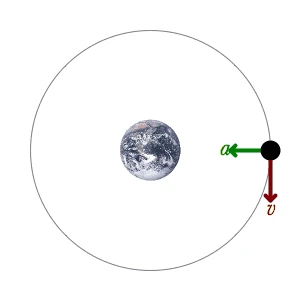
Classical mechanics
Theory of forces and motion for macroscopic objects.

David, but not Hilbert · CC BY-SA 4.0
Classical mechanics is a theory in physics that describes the effect of forces on the motion of macroscopic objects and bulk matter, without considering quantum effects and often without incorporating relativistic effects. It is used to describe the motion of objects such as projectiles, parts of machinery, spacecraft, planets, stars, galaxies, deformable solids, fluids, and macromolecules. The development of classical mechanics involved substantial change in the methods and philosophy of physics, and the qualifier 'classical' distinguishes it from new methods developed after the revolutions in physics of the early 20th century.
- field
- Physics
- known_for
- Describing motion of macroscopic objects under forces; basis for Newtonian mechanics, analytical mechanics, and branches such as statics, kinematics, and dynamics
Lore & Background
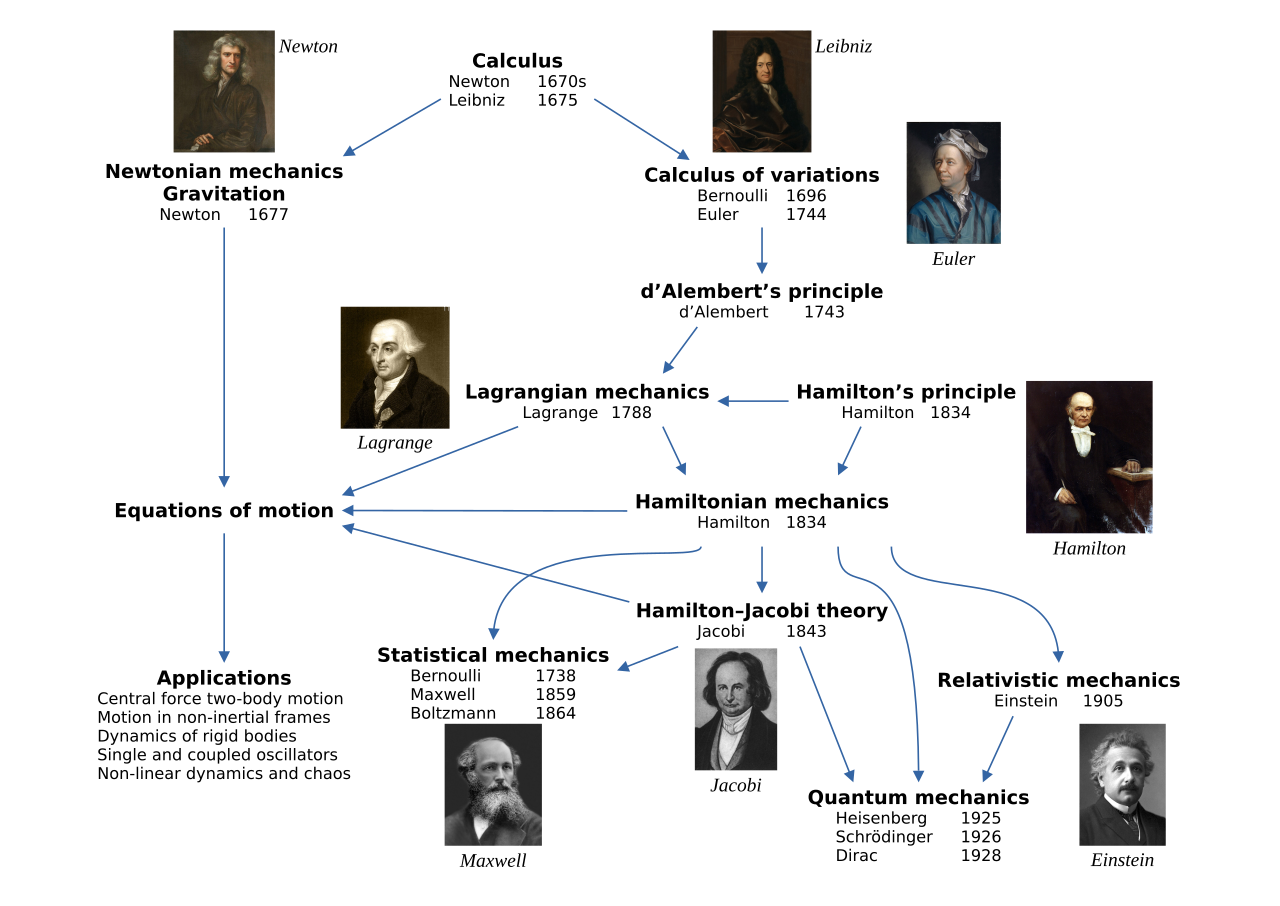
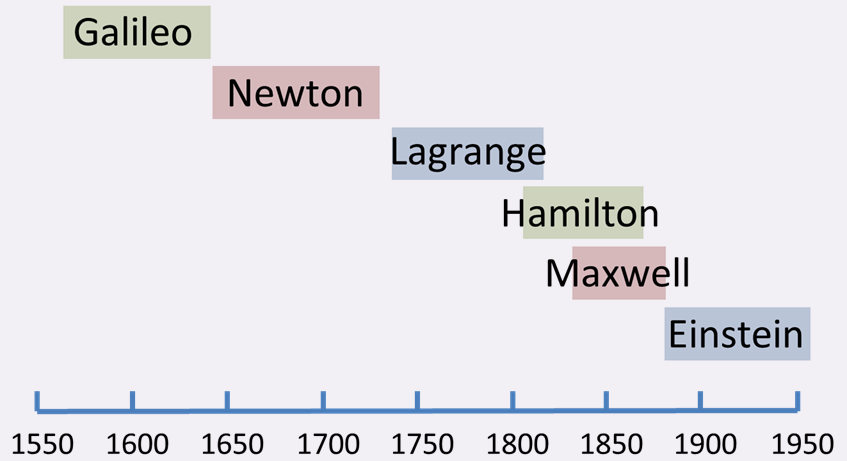
The earliest formulation of classical mechanics is often referred to as Newtonian mechanics, based on the 17th century foundational works of Sir Isaac Newton and mathematical methods invented by Newton, Gottfried Wilhelm Leibniz, Leonhard Euler and others. Later, methods based on energy were developed by Euler, Joseph-Louis Lagrange, William Rowan Hamilton and others, leading to analytical mechanics, which includes Lagrangian mechanics and Hamiltonian mechanics. These advances, made predominantly in the 18th and 19th centuries, extended beyond earlier works and are used in all areas of modern physics.
Reader's Guide
Classical mechanics provides accurate results when studying objects that are not extremely massive and have speeds not approaching the speed of light. With objects about the size of an atom's diameter, quantum mechanics becomes necessary; for velocities approaching the speed of light, special relativity is needed; for extremely massive objects, general relativity applies. Chaos theory shows that long-term predictions of classical mechanics are not reliable. Classical mechanics was traditionally divided into statics, kinematics, and dynamics. Another division is based on mathematical formalism: Newtonian mechanics emphasizes force as a vector quantity, while analytical mechanics uses scalar properties like kinetic and potential energy. Branches by region of application include celestial mechanics, continuum mechanics, relativistic mechanics, and statistical mechanics. Classical mechanics models real-world objects as point particles or aggregates of particles, and assumes that matter and energy have definite attributes such as location and speed, with non-relativistic mechanics assuming forces act instantaneously.
Did You Know?
- Classical mechanics was traditionally divided into three main branches: statics, kinematics, and dynamics.
- Analytical mechanics includes Lagrangian mechanics and Hamiltonian mechanics, which are equivalent by a Legendre transformation.
- Noether's theorem, a result from the principle of least action, connects conservation laws to their associated symmetries.
- Classical mechanics assumes Euclidean geometry for the structure of space and absolute time in pre-Einstein relativity.
From Bernoulli to Gibbs: The Founding Generation
The story of statistical mechanics stretches back further than most realize. That insight would echo for centuries.
Explaining the Macroscopic from the Microscopic
At its heart, statistical mechanics is a mathematical framework that marries probability theory with the physics of large collections of microscopic entities. Its central mission is to explain the aggregate properties of matter—temperature, pressure, heat capacity—by referring back to the physical laws that govern atomic motion. Rather than tracking every particle, it characterizes systems through parameters that fluctuate around average values and are described by probability distributions. This approach grew out of classical thermodynamics, which had long dealt with equilibrium states, and statistical mechanics succeeded in grounding those macroscopic quantities in microscopic behavior. The framework's reach extends well beyond physics proper. Applications span biology, neuroscience, computer science, information theory, and even sociology, wherever large assemblies of interacting units must be understood through statistical rather than individual tracking. In essence, it provides a bridge between the deterministic world of single-particle mechanics and the probabilistic reality of everything we observe at human scales.
The Ensemble: Bridging Law and Experience
A persistent puzzle in physics is the gap between fundamental mechanical laws and everyday experience. In both classical and quantum mechanics, the complete state of a system at any instant—encoded as a phase point or a pure state vector—together with an equation of motion (Hamilton's equations or the Schrödinger equation), allows in principle the calculation of the state at any other time. Yet in practice, no one performing a chemical reaction needs, or can know, the exact simultaneous positions and velocities of every molecule involved. Statistical mechanics resolves this disconnect by introducing the statistical ensemble: a vast collection of virtual, independent copies of the system, each occupying a different possible state. The ensemble is not a single trajectory but a probability distribution spread across all accessible states. In the classical setting this distribution lives over phase points in a phase space with canonical coordinates; in the quantum setting it lives over pure states. By adding a layer of uncertainty about which state the system occupies, the ensemble formalism reconciles the precision of mechanical laws with the practical reality of incomplete knowledge.
Beyond Equilibrium and Into the Quantum Age
Classical thermodynamics was primarily an equilibrium discipline, but statistical mechanics proved far more versatile. Its methods were extended into non-equilibrium statistical mechanics to model the speed of irreversible processes driven by imbalances—chemical reactions, particle flows, heat conduction. The fluctuation-dissipation theorem emerged as a foundational result from applying these non-equilibrium tools to the simplest case of a steady-state current in a many-particle system. Although his methods were originally derived within classical mechanics, their generality meant they adapted seamlessly to quantum mechanics once it emerged. That adaptability has ensured that Gibbs' framework still underpins statistical mechanics today.
Gallery
Frequently Asked Questions
Who is Classical mechanics?
Classical mechanics is the foundational framework in physics that maps out how forces influence the movement of everyday-scale objects, from thrown balls to orbiting planets. It operates without invoking quantum behavior or relativistic corrections, making it the go-to tool for macroscopic motion.
What are Classical mechanics's powers and role?
It governs the trajectories of projectiles, the gears in machinery, the paths of spacecraft, and the orbits of celestial bodies. It also extends to deformable solids, flowing fluids, and even macromolecular structures, covering a remarkably wide range of physical systems.
How does Classical mechanics's story end?
Its narrative reaches a boundary where quantum effects and relativistic corrections become unavoidable, ceding the stage to those newer theoretical frameworks. The qualifier 'classical' exists precisely to mark where its methods stop and the post-revolution approaches begin.
Why is Classical mechanics important?
It laid the groundwork for Newtonian mechanics, analytical mechanics, and the sub-branches of statics, kinematics, and dynamics. Its development also reshaped the very methods and philosophy physicists use to approach problems, fundamentally changing how the field operates.
What branches does Classical mechanics include?
It encompasses statics (equilibrium of forces), kinematics (describing motion without identifying its cause), and dynamics (linking forces directly to resulting motion). Together these sub-fields form the toolkit for analyzing everything from a stationary bridge to a spinning galaxy.
More in Classical Mechanics 1-21
Spotted an error? Know more?
This is a living reference — every entry is fact-audited, and reader corrections feed straight into our audit queue. Suggest an edit · See this site's audit record